


Cairo – Egypt's Pyramids and Museums
Giza Plateau and two museums – the way to the Mediterranean
Giza Plateau and two museums – the way to the Mediterranean
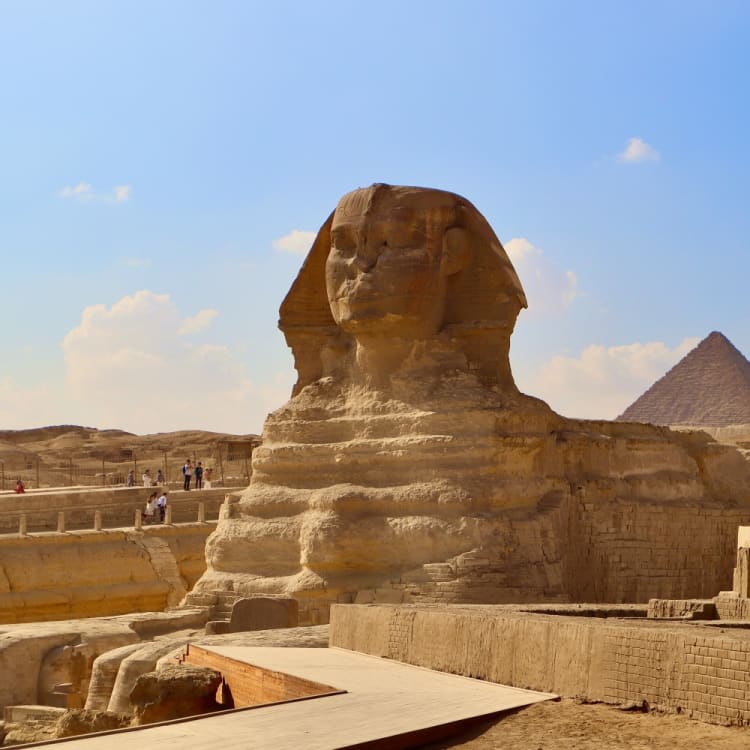
On the western edge of Cairo, on the Giza plateau, stand Egypt's pyramids – three royal tombs of the fourth dynasty, along with the Great Sphinx next to the Valley Temple of Khafre. The plateau closes both authorities' entrances in the afternoon. At the edge of the same plateau stands the Grand Egyptian Museum.
Cairo in Egypt hosts two large pharaonic collections, and what one shows has been handed over by the other. The Grand Egyptian Museum in Giza has been open to the public since November 4, 2025, and today features the complete Tutankhamun collection. The Egyptian Museum in Cairo on Tahrir Square remains open, with the statues of the three pyramid builders and the Narmer Palette.
Cairo appears as its own stage in all six Egypt itineraries from Orient Memories. The entry stage lasts three to four nights, and for three of the six trips, an additional return night is added at the end. This page organizes what can be reached from Cairo in Egypt and notes where the sources provide no information. Where a detail is missing, that is made clear here as well.

Best travel time
Arrival and routes from Cairo
The details here relate to long-distance connections from Cairo, not urban routes. No German-speaking provider in the examined price band offers the night train to the south, although a night trip replaces a hotel night and a domestic flight. No vehicle class is mentioned in this price band either. The ships themselves travel between Luxor and the first cataract – they operate on their own route to the Nile cruises .
1# Night train to the south
Operator Abela Trains since 2023, previously Watania – almost all German-language texts still mention the old operator.
2# Departure station
not from Ramses, but from Bashtil station, and some travelers board in Giza.
3# Trains per day
trains 82, 83, 86, and 87 daily, trains 1086 to 1089 as needed or on certain weekdays.
4# Sample schedule
Train 86 departs at 19:45, arrives in Aswan at 09:25, return Train 87 departs at 17:15, arrives in Giza at 06:05 – dinner and breakfast included in the fare.
5# Scheduled flight to Aswan
41 flights per week, five specifically named airlines, flight time 1 hour 20 minutes, first departure 04:00, last 23:20.
6# Road to Alexandria
219.6 kilometers by private car, without domestic flight.
7# Cairo in the program
Entry stage three to four nights, total stay three to five nights, seasonal value of all six Egypt trips from the house October to April – the same value applies to the other Orient trips.
Pyramids of Giza – inside and outside
The pyramids at the gates of Cairo have no reliable opening hours. The same authority provides two versions for the same site – the area page for the plateau states 8 AM to 4 PM, the page for the Great Pyramid states 7 AM to 5 PM, both every day. What is reliable is not the opening, but the closing, which is in both versions in the afternoon – the area page does not mention a final entry time, nor does it track summer or winter time.
The area ticket for the plateau does not cover interior visits. According to the ministry, all three pyramids are excluded from the interior, as are the tomb of Meresankh III and the workers' settlement, and each of these visits requires its own additional ticket. Therefore, anyone wanting to see the King’s Chamber must buy twice. This applies regardless of which provider the trip is booked through, as the authority bills the area and the individual monuments separately.
The Great Pyramid of Khufu has three chambers – one cut into the rock, two high in the masonry. The upper one is the King’s Chamber, where the sarcophagus still stands today, and the path to it leads through the Grand Gallery. Authorized private visits also allow access to the Queen's Chamber and the Grotto; for regular visits, no one indicates that. The solar barque of Khufu is no longer located at the plateau since the move, but in a specially constructed hall in the Grand Egyptian Museum.
In the examined comparison field, no provider lists paid special tickets as an inclusive service. One explicitly excludes them, while the others do not mention them at all. Anyone wanting to see the interior in Giza must plan it separately. The ticket structure of the authority separates area and monument, and at this dividing line, it is decided what a service includes.
How many interior tickets the plateau in Giza issues daily is not published by the authority. Online, there are circulating fixed quota numbers for the morning and a second for the afternoon, but no page of the authority carries these figures, not even the ticket section. The ministry also does not mention special opening hours for the interior, only that individual monuments require their own tickets.
The three pyramids and the Sphinx
The Great Pyramid of Khufu was built for King Khufu and was the tallest structure in the world for 3,800 years, originally 146.5 meters high. Khafre measures 143.5 meters and sits on slightly higher ground, making it appear equal in height from a distance. Menkaure is considerably smaller, and the lower quarter of its casing bears granite from Aswan, over eight hundred kilometers away from Giza.
The Great Sphinx is architecturally part of Khafre's complex and stands next to his Valley Temple. The authority does not provide a current height for any of the three pyramids. Each royal pyramid was just one element of a larger complex made up of subsidiary pyramids, mastaba tombs, and two temples, connected by an ascending causeway, and the mortuary and Valley Temples of Khafre are counted by the authority among the best-preserved of the Old Kingdom.
Grand Egyptian Museum – Egypt's new museum
The new Egyptian Museum in Cairo is not located in the city center but at the edge of the Giza plateau. Trial operations began in October 2024 and only showed the entrance hall, the staircase over six levels, and individual thematic galleries. The opening ceremony took place three days before the public opening, and since November 4, 2025, anyone with a valid ticket can enter.
Two dates thereafter regulate two different things, and the market regularly uses them interchangeably. Since November 16 of the same year, a assigned time window applies to all visitors; from December 1, online booking is the only sales method – one indicates when you enter, the other where to buy. Sales at the museum's counters ended with this, even on weekends and holidays.
The time window does not limit the duration of stay, only entry. The last entry is one hour before the galleries close. The authority describes this museum as a fully digitally operated facility with timed entry and explicitly contrasts it with the older house at Tahrir Square in Cairo.
For a German-speaking provider, this hinges on a practical point: Guided tours are only available in English and Arabic online, everything else goes through an inquiry mailbox, and therefore, a German-speaking tour becomes an inquiry process and not a booking transaction. The trip " Experience Egypt exclusively " includes this museum in its Cairo stage of three nights and lasts a total of fourteen days. On Wednesday, September 2, 2026, the museum was closed for one day without the authority providing a reason.
In the German internet, the opening is still indicated at some places as being in the future. One provider holds one of the top spots with one of the museum's keywords and continues to state that the house will "officially open in 2025," while the introductory text of the same page already indicates the opening as having occurred. A second page describes trial tours that are supposed to show at least part of the museum, thus considering the house not yet opened ten months after the public opening.
Evening opening on Wednesdays and Saturdays
Two weekdays remain open longer than the other five. The galleries otherwise close early in the evening; on Wednesdays and Saturdays, they close at 9 PM, and the last entry is also one hour earlier. This is the only officially documented time window with structurally fewer group visits – a second does not provide any source in all the collected material, neither the authority nor a provider.

Capacity and influx
The Egyptian cabinet stated on December 14, 2025, that around 15,000 visitors daily is the maximum daily capacity of the house. This is the only daily ceiling that can be officially documented for an Egyptian major site. For summer 2026, however, the operating authority states an average of 7,000 to 10,000 visitors a day. Both numbers together state: In summer 2026, the declared upper limit is not reached.

Documented and open statements
What we can document — and what not
The official series on the Grand Egyptian Museum is clear. The director of the house states that from the public opening to the end of July 2026, there have been well over three million visitors, over 60 percent of whom are from abroad. The same magnitude was mentioned by the director himself seven weeks before this interview and by the tourism minister a day later. Thus, two different agencies have provided this figure.
In the internet, a visitor number more than double that is circulating. It appears in articles without any measurement period and does not match the information provided by the operating authority of the Grand Egyptian Museum itself, as it is earlier and much higher. No source accountable for it is named in any of these articles, and that properly belongs to it.
Thus, two things are not listed on this page. For the Grand Egyptian Museum, the same government agency provides two different object numbers, and for the house at Tahrir Square, none at all – hence no object number is listed here. And for the route between Cairo and the plateau, four different kilometer figures are circulating, none of which are attributed to an authority.
Information researched in September 2026.
Egyptian Museum in Cairo – the collection at Tahrir
Cairo's pharaonic collections are currently spread across three houses. The Grand Egyptian Museum is located in Giza, the National Museum of Egyptian Civilization is in Fustat, and the Egyptian Museum in Cairo is situated at Tahrir Square. Anyone who does not distinguish between the three houses seeks Tutankhamun in the wrong place and the royal mummies in the second wrong place – the house at Tahrir Square is the oldest of the three and has handed over large collections twice.
The complete Tutankhamun collection and the solar barque of Khufu were transferred to the new house in Giza, and on April 3, 2021, the authority moved twenty-two royal mummies and seventeen royal sarcophagi to the National Museum in Fustat. Among the mummies were eighteen kings and four queens from four dynasties, including Ramses II, Seti I, Thutmose III, and Hatshepsut. None of these collections remain at Tahrir Square today.
What remains is what the authority currently names. At Tahrir Square are the Narmer Palette representing the unification of Upper and Lower Egypt, the treasures of Tanis, and the complete burials of Yuya and Thuya. Also located there are the statues of Khufu, Khafre, and Menkaure, the builders of the three pyramids, including the granodiorite statue of Khafre with the Horus falcon behind his head. Anyone wanting to see the builders will not find them in Giza but here.
The house originates from an international architect competition, the first of its kind, and Khedive Abbas Helmy II opened it in 1902. Over a hundred exhibition halls are spread over two floors. It is open from 9 AM to 5 PM every day, the ticket office closes one hour earlier, and during Ramadan the house closes one hour earlier. According to the authority, it is the oldest archaeological museum in the Middle East and houses the largest collection of pharaonic antiquities in the world.
Regarding the future of the house, the authority publishes nothing – no restructuring, no renovation, no timetable. The most recently documented project is a European Union-funded initiative with five European museums, which concluded in February 2023 with a master plan. Anyone seeking short distances to this collection finds it in the The St. Regis Cairo , whose description leads to the museum and Tahrir Square as a minute's walk while explicitly stating Giza as a longer excursion.
Access outside of opening hours
The Giza plateau closes in the afternoon, and everything before and after lies outside of opening hours. Three things run under the same word in the market: genuine special openings with official permission, early access to the regular opening, and private tours during opening hours – and only the first is an official procedure. The difference lies in the permission.
Genuine special openings are credited at four sites in the country. Two of them are located in Giza – the Great Pyramid of Khufu and the enclosure of the Sphinx – the other two are the Sekhmet Chapel in Karnak and the Osireion in Abydos. No other site in the country has any of the surveyed sources named such a procedure, and the authority’s own page does not mention private visits anywhere.
For the Great Pyramid of Khufu, two providers name two different time windows for the same procedure, 5 PM to 7 AM and 9 PM to 5 AM, and both specify two hours without interruption, with an Antiquities Inspector mandatorily accompanying the group. Both windows are entirely outside of opening hours. The permission comes from three authorities – the Ministry of Tourism and Antiquities, the Ministry of Interior, and the supervision of the pyramid area – and the lead time is at least five working days.
The enclosure between the paws of the Sphinx is closed during the day. For this, a window from 5 AM to 7 AM is documented, lasting one hour, with at least seven days' notice needed for the security permission. In Giza, three separate applications are necessary, one for the Great Pyramid, one for the Sphinx, and one for the plateau.
At the two Cairo museums, this is not the case. No product is documented for either the Grand Egyptian Museum or the house at Tahrir Square, and anyone selling "VIP" there means a private tour within opening hours. None of the first three places named among the 15 noted cairo searches mention access outside of opening hours.
In the market, three different meanings are being used for these terms. A visit to the museum at Tahrir Square offered as "Exclusive Visit" explains in its own text that it only refers to the guide. One provider promotes "private insights off hours," without naming a single site, a time, or a means of obtaining a permit. Therefore, this page describes the process without making any promises.
Cairo's museums and attractions
The itineraries of this house cover eight entries content-wise in Cairo, from the Giza plateau through the Saqqara necropolis to the bazaar and the districts by the river. Saqqara is not its own stage but part of the Cairo day. The city is most densely covered in " Egypt off the beaten path ", as it is the only itinerary that includes Saqqara and Zamalek. Individual structures like the Babylon Fortress or the Ibn Tulun Mosque are subpoints of these eight entries.

Saqqara and Coptic Cairo
The Saqqara necropolis is listed in the itineraries as part of the Cairo stage, and the same applies to Coptic Cairo with the Babylon Fortress. Saqqara is not its own stage in any of the six routes. Entries, opening hours, and time requirements for these two locations are not found in any source used by this page, and they are therefore not listed here.
Islamic Cairo and its mosques
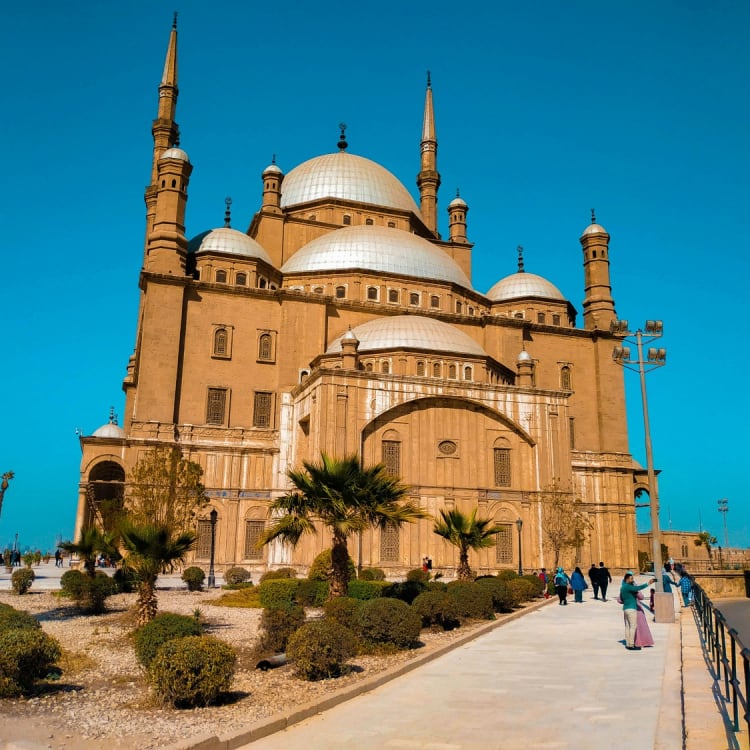
Three mosques shape Islamic Cairo. The Ibn Tulun Mosque and the Sultan Hassan Mosque are part of the Cairo day in the itineraries, while the Muhammad Ali Mosque stands high above the city center in the Citadel. No construction dates are provided by any of the sources used for these three mosques, which is why it only says which of them appears in which trip.
Khan el-Khalili, Zamalek, and Gezira
The Khan el-Khalili bazaar is alongside two districts by the river in the itineraries. Zamalek and Gezira lie on the island in the Nile, and both are included in the itineraries as part of the Cairo stay. Anyone looking for the bazaar will find it in Old Cairo and not near the plateau. All three entries thus belong to the city day and not to the day in Giza.

Alexandria by the Mediterranean
Alexandria in Egypt lies by the Mediterranean, founded in 331 BC by Alexander the Great and regarded by the ministry as the most important city in the eastern Mediterranean until the 5th century. Alexandria's attractions lie in a different epoch layer than Giza, and the coast follows a different seasonal logic than the inland: This page organizes the months by sightseeing season in Cairo, not by a bathing season at the Mediterranean. The epoch span of the sites extends to Byzantine times.
From Cairo to Alexandria
Two nights, not one day. This is how it solves " From the pyramids to the Mediterranean coast ", the only trip from the house that includes a dedicated stage for Alexandria: four nights in Cairo beforehand, two in Alexandria, one afterward, with a minimum duration of eight days. The route is traveled by private car over 219.6 kilometers, with no travel time specified here. Five sources name durations between two and four hours, depending on the mode of transport, and a reliable figure for the private car is missing.

Alexandria's old town and the Qaitbay Fortress
The Qaitbay Fortress stands on the remains of the Lighthouse of Alexandria, built between 1477 and 1479 from limestone over approximately 17,550 square meters. The main tower in the northwest features four semicircular corner towers. In the theater of Kom el-Dikka, deemed by the ministry the only one of its kind in Egypt, lie marble seating rows and mosaic-clad galleries from Roman and Byzantine times, alongside Roman baths with underfloor heating.
The catacombs of Kom al-Shoqafa are Roman-era, and their sculptures blend Egyptian and Greek traditions in a tomb. The Pompey’s Pillar from the late 290s is correctly called Diocletian's Pillar, and the authority explicitly notes this naming error. The associated Serapeum fell victim to the prohibition of ancient cults in 391. The Bibliotheca Alexandrina includes four museums and a planetarium, and on Fridays, the reading room, museums, and planetarium remain closed.

Three houses in Cairo and Alexandria
The St. Regis Cairo features 360 rooms, suites, and serviced apartments. The Metropolitan Suite measures 66 square meters, the Deluxe room 46, and the windows stretch from floor to ceiling with views of the Nile or historic Old Cairo. Seven dining establishments and a spa spanning two floors are included, and the butler service is offered by the house as a separate service.
The location of this house explains why it is included on this page. Its description names the Egyptian Museum at Tahrir Square as just a few minutes away, Islamic Cairo and the bazaar as reachable by car – and Giza explicitly as a longer excursion. Anyone wishing to see the collection at Tahrir Square twice will find it ideal here.
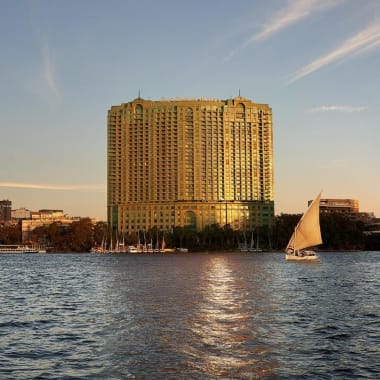
The Four Seasons Hotel Cairo at Nile Plaza is also right on the riverbank, with views of the Nile, the city, or the pyramids. The operator does not provide further information: the number of rooms, categories, and square meters are not disclosed, neither in their own inventory nor on the house's pages, which restrict automated inquiries. This is stated here because an estimated figure would not be valid. In three of the six itineraries, it is the designated Cairo hotel.
The Four Seasons Hotel Alexandria at San Stefano stands with 29 floors on the site of the former San Stefano Grand Hotel, designed by interior architect Pierre-Yves Rochon. The house includes a private 500-meter sandy beach and a tunnel beneath the riverside street so that guests do not have to cross traffic. The spa occupies two floors with fourteen treatment rooms, and three pools are spread over the roof, inside the hotel, and by the beach. Room count and square meters are also not disclosed here.
That these details matter at all is shown by looking into the field. In the examined comparison field, seven of 32 surveyed pages mention square meters, and none of them are location pages, while some categories in the market bear names indicating limited viewpoints instead of beautifying them. Where an operator discloses nothing, this page states 'not disclosed' along with the reason.
Trips with Cairo Stopover
Three of the six trips with a Cairo stopover are listed here. Two of them start with four nights and return for one more, the third lasts three nights and includes the Grand Egyptian Museum in its Cairo stopover. The sites included in each trip are detailed in the respective itinerary.


on request
Hotels in Cairo and Alexandria
Two of the three hotels are located in Cairo, the third in Alexandria by the Mediterranean. Categories, amenities, and conditions for each hotel are listed one click level deeper on the page of the respective hotel. This page only mentions square meters where the operator specifies them.


Frequently Asked Questions about Cairo and Giza
How old are the Pyramids of Giza?
The three pyramids are tombs of kings from the 4th dynasty. For the Great Pyramid, the Egyptian Ministry of Antiquities states the years c. 2589–2566 BC, and estimates the construction time at ten to twenty years, noting that it is still not fully clarified how this happened. There is no specific date for the start of construction.
How tall are the Pyramids of Giza?
The Great Pyramid was originally 146.5 meters tall, Khafre 143.5 meters, and Menkaure 65 meters, and Khafre only appears to be as tall as the Great Pyramid because he is situated on slightly higher ground. All three values come from the Egyptian Ministry of Antiquities. The same authority does not provide a current height for any of the three pyramids – that is the answer and not an omission.
How many days are needed for Cairo?
The six itineraries of this house set the Cairo entry stage at three to four nights, and for three of the six trips, an additional return night is added, resulting in a stay of four or five nights. Content-wise, eight items are covered during this time, from Giza and Saqqara to the bazaar and the districts along the river. If you add Alexandria, you count two more nights, and the only trip with its own Alexandria stage is set for a minimum duration of eight days.
How do you book tickets for the Grand Egyptian Museum?
Exclusively online, and for a fixed time window. Since November 16, 2025, this time window applies to all visitors, and since December 1 of the same year, online booking is the only sales channel, even on weekends and holidays. The time window controls entry and does not limit the duration of stay. The last entry is one hour before the galleries close.
When does the Giza Plateau open?
The same authority provides two answers. The area page for the plateau states 08:00–16:00, the page for the Great Pyramid 07:00–17:00, both on all seven days. Therefore, the afternoon closure is reliable and not the opening time. The area page does not specify a last entry and seasonal hours.
What can still be seen at Tahrir Square after the move?
Tutankhamun and the solar barque are in the Grand Egyptian Museum, the royal mummies since 2021 in the National Museum in Fustat. The Narmer Palette, the treasures of Tanis, the burials of Yuya and Thuya, and the statues of the three pyramid builders remain at Tahrir Square. The house opened in 1902 and is, according to the authority, the oldest archaeological museum in the Middle East. The authority does not specify the number of objects for the house.