

Luxor – Egypt's Temples and Tombs
East Bank and West Bank – Karnak, Kings' Tombs, Hot Air Balloon Rides
East Bank and West Bank – Karnak, Kings' Tombs, Hot Air Balloon Rides
On both banks of the Nile lies Luxor – Egypt's temples are in the east, its kings' tombs in the west. On the East Bank are the Karnak Temple and, about three kilometers further south, the Luxor Temple; on the West Bank is the Valley of the Kings with the burial sites of the New Kingdom. Therefore, anyone planning the city of Luxor should plan for two banks and no center.
The Ministry of Tourism and Antiquities cites the solar cycle as the reason why the tombs are located in the west – the sun god set there to be reborn in the east. Cemeteries in Egypt were therefore generally located on the west bank of the Nile and not just those of Luxor.
Luxor stands as its own station on the journey through Egypt: two nights in the city, and on the West Bank the house Al Moudira. The route on the water itself is described by the Nile Cruises .

Best Travel Time
Arrival and Routes to Luxor
Scheduled flights and night trains begin in Cairo . A road from Hurghada leads to Luxor.
1# Scheduled flight to Cairo
Shortest flight time 1 hour 10 minutes. Pharaoh's history meets tranquility at the Red Sea reaches Luxor this way.
2# Night train from the north
Daily, overnight, between Cairo and Aswan .
Hot air balloon over Luxor – flight operations and cancellations
For balloon flights, a governmental regulation applies over Luxor: The Civil Aviation Authority permits balloon flights only west of the Nile, crossing to the east bank is prohibited, and the balloons must maintain distance from the approach traffic of Luxor Airport. There is also an altitude limit that establishes the same rule. The launch site is on the West Bank, just a few steps from the Ramesseum.
From June 1 to August 30, the authorities suspended all commercial balloon flights, citing the summer temperatures in Upper Egypt, and since September 15, the balloons have resumed flying, initially without passengers.
Even in the high season, the authorities stop operations, and the halt applies to all balloon companies at once. The reason is always the wind condition: Wind speed was above the safe takeoff limit, along with a shift in wind direction from west to east and sudden turbulence in the upper air layers. A balloon flight in Luxor is not a schedule but an option subject to weather conditions.
Experience Egypt exclusively leads the hot air balloon over Thebes-West in the course.
Balloon ride in Luxor – basket and process
The takeoff is about half an hour before sunrise. The flight duration is 30 to 45 minutes, flying is exclusively over the West Bank, and an operator specifies 20 to 30 people per basket, besides special balloons for two or four.

The Valley of the Kings in Egypt
Above the Valley of the Kings near Luxor stands a pyramid-shaped mountain peak, which the Ministry of Tourism and Antiquities interprets as a sign of the divine and assigns to a funerary aspect of Hathor, the Mistress of the West.
The ministry writes of over sixty tombs in the valley. Additionally, there are twenty other unfinished ones, which are hardly more than pits. Here lie the rulers of the eighteenth, nineteenth, and twentieth dynasties of the New Kingdom, which began around 1550 B.C., as well as family members and individual high-ranking non-royals. The valley divides into east and west, and in the west valley, there are only a handful of tombs.
The valley is open daily from 6 a.m., and the last admission is at 5 p.m. in the summer, 1 hour earlier in winter and Ramadan. For all sites, the ministry states that one should arrive at least one hour before closing, and this applies to the entire West Bank. Taking photographs with mobile phones is free.
Five tombs on the West Bank have a separate ticket in addition to the basic ticket. The official price list of the Ministry of Tourism and Antiquities lists them by name: Tutankhamun, Ramses V. and Ramses VI., Seti I., Eje, and Nefertari. None of these are listed on the booking platform of the same ministry, and the tickets are only available on-site.
Tombs in the Valley of the Kings
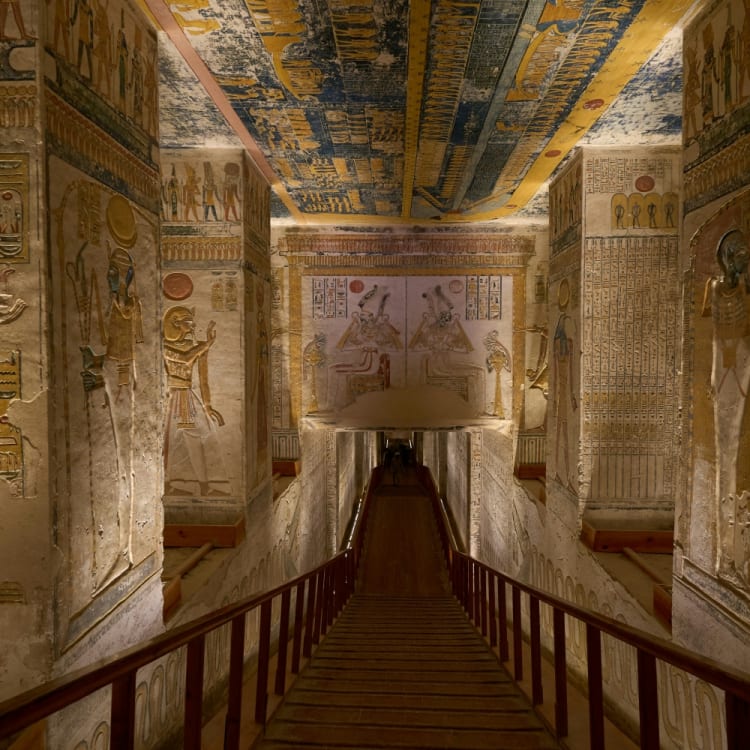
In the Valley of the Kings near Luxor, it is not about a pyramid but about corridors in the exposed rock. Thutmose I, whom the ministry lists as the third king of the eighteenth dynasty, is the first securely documented king of the valley.
The Hatshepsut Temple on the West Bank
The temple is called Djeser-djeseru, "the Holy of Holies", and is located in Deir al-Bahari. It was designed by the Amun steward Senenmut and stands directly opposite Karnak, with three levels, each carrying a colonnade at the back end. On the top level, mummy-shaped statues of Hatshepsut as Osiris lean against the pillars.
It is the mortuary temple of the queen who became pharaoh, but it also has five other cults – Thutmose I, Hathor, Anubis, Ra-Harakhti, and, first and foremost, Amun. Its sanctuary leads at the end of the upper courtyard into the rock.

The Karnak Temple in Luxor
The ancient Egyptians called the complex Ipet-Sut, "The Most Select of Places". Karnak is not a single temple but a union of four districts – the Amun district as the largest, the Mut district in the south, the Month district in the north, and Akhenaten's temple for Aton in the east. Additionally, there are the Chons Temple, the Opet Temple, the sacred lake, and at the eastern end, Thutmose' III Ach-menu. Anyone planning the Karnak Temple plans a complex and not a single building.
The earliest evidence dates back to the reign of Intef II, and the last construction work extends to the Ptolemaic period, with additions during Roman times. Almost every king of the New Kingdom has built here.
The Hypostyle Hall of Karnak
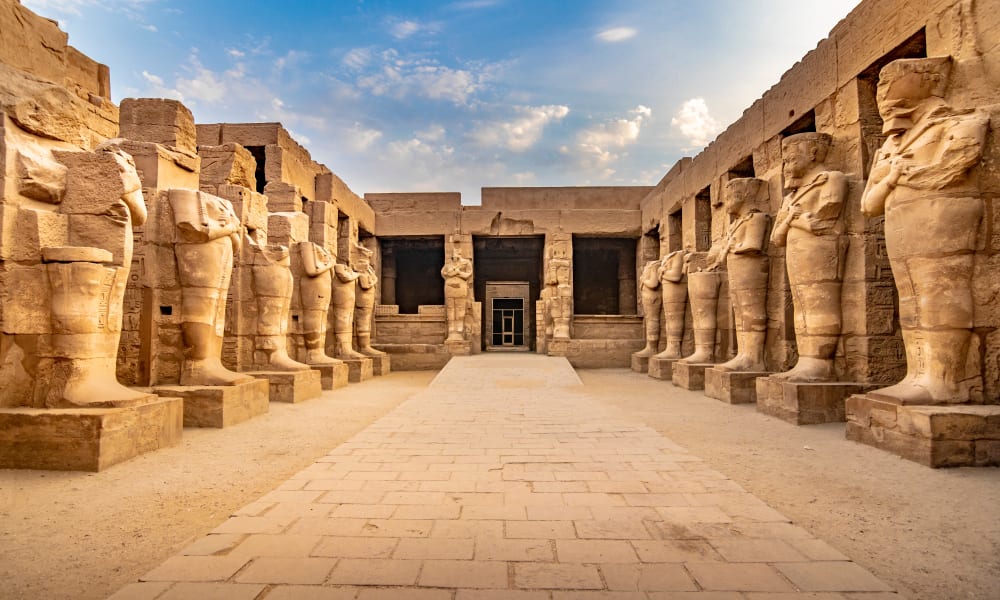
The Great Hypostyle Hall has 134 columns, of which only the twelve middle ones reach 21 meters, while the others measure 15 meters. The hall may have been initiated by Amenhotep III, with Sethos I and Ramses II having built and decorated it.
The complex is open all seven days of the week from 6 a.m. to 5 p.m., and the last admission is at 4 p.m., during summer, winter, and Ramadan equally.
The Sound-and-Light-Show in Karnak
Two performances are scheduled each evening – 8 p.m. in English, 9 p.m. in all languages, and instead on Thursdays in Arabic. The second performance only takes place if a minimum number of participants is reached.
The Luxor Temple on the East Bank
The temple was called Ipet-resyt, "Southern Sanctuary", and is located approximately three kilometers south of the Karnak Temple, which was connected to it by an avenue of sphinxes. Unlike most other Egyptian temples, it does not follow an east-west axis but points towards Karnak – due to the Opet Festival, when the cult images of Amun, Mut, and Chons moved here.
Several rulers worked successively on the construction. The oldest surviving component is a shrine of Hatshepsut; the core comes from Amenhotep III, and the peristyle courtyard and pylon go back to Ramses II. The Great Colonnade consists of two rows of seven colossal columns each, and according to the ministry, Tutankhamun and Haremhab completed its decoration. The complex has thus grown over several dynasties.
In the late third century, the Romans built a fortress around the temple. The paintings inside depicted Emperor Diocletian and his three co-regents. The ministry notes that most of them have mostly disappeared and that restoration work is being done. What is visible at the Luxor Temple today comes from several epochs.
The Obelisk of Luxor
In front of the pylon stood a pair of 25-meter-high obelisks of Ramses II. Only one still stands there; the other has been in the Place de la Concorde in Paris since the nineteenth century.
Evening entry at the Luxor Temple
The temple is open every day until 8 p.m. according to the ministry. The last admission is at 7 p.m., equally in summer, winter, and Ramadan. Karnak Temple, Luxor Temple, Valley of the Kings, Hatshepsut Temple, Valley of the Queens, Medinet Habu, and Ramesseum – only the Luxor Temple allows evening entry among these seven sites, and the Luxor Museum is not included.

Luxor's Attractions on Both Banks
Luxor's attractions are distributed across two banks: On the East Bank are the Karnak Temple and the Luxor Temple, on the West Bank are Thebes-West with the Valley of the Kings, Deir al-Bahari, the Valley of the Queens, Medinet Habu, and the Ramesseum. A Journey Through Millennia explicitly leads to the West Bank, and those with only one day should therefore plan according to banks and not individual sites.
The ministry's booking platform lists ten sites and museums for Luxor: Luxor Temple, Karnak Temple, Hatshepsut Temple, Deir el-Medina, Valley of the Kings, Luxor Museum, Medinet Habu, Mummification Museum, Ramesseum, and the tombs of the nobles.
The Colossi of Memnon on the West Bank
The Colossi of Memnon on the West Bank of Luxor do not require a ticket; access is free.
The Luxor Museum on the East Bank
The Luxor Museum opens twice a day and not continuously: In summer, it admits guests from 9 a.m., last entry at 12 p.m., and again from 5 p.m. with a last entry at 7 p.m. In winter, the two windows close at 1 p.m. and 8 p.m., and during Ramadan one hour earlier in the evening. In the Luxor Museum, taking photographs with mobile phones is free, and children under six years have free admission.

Al Moudira on the West Bank of Luxor
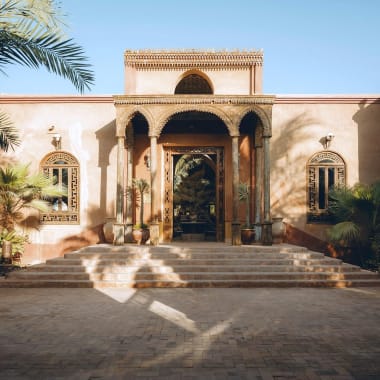
Al Moudira is located on the West Bank of Luxor, near the Valley of the Kings. The house was founded by Zeina Aboukheir, and the name means "the Boss" in Arabic – this is what the workers and craftsmen at the construction site called her. It was designed by the Egyptian architect Olivier Sednaoui, trained in London, along with Swiss landscape architect Tobias Bucher and Egyptian architect Dina Abou Alia.
The house features 54 suites around ten courtyards. In addition, there are villas under the name Moudira Collection, separate from the suites.
Six suite categories in Al Moudira
The suites are divided into six categories, all with designated areas. They are called Deluxe Suite, Junior Suite, Signature Suite, Luxury Suite, Fountain Suite, and Family Suite. The range goes from 50 to 55 square meters in the smallest category to 100 square meters in the largest.

Round trips with Luxor stopover
Three trips include Luxor as a separate stop with two nights each. In all three cases, the same house on the West Bank appears in the itinerary, and the durations range from nine to fourteen days. The longest comes by Dahabiya, a second by ship from the south, and the third by domestic flight from Cairo.

on request
on request

Hotels in Luxor
The historic Mandarin Oriental Winter Palace in Luxor is closed and is set to reopen in July 2027, according to the operator.
Frequently Asked Questions about Luxor
Where are Luxor and the Valley of the Kings located?
Luxor is located on the Nile, and the city is divided into two banks. On the East Bank are the Karnak Temple and the Luxor Temple, about three kilometers between them according to the authorities. On the West Bank lie the kings' tombs, and the Ministry of Tourism and Antiquities justifies this with the solar cycle – the sun god set in the west.
What is the Valley of the Kings?
It is the burial site of the rulers of the eighteenth, nineteenth, and twentieth dynasties of the New Kingdom, and the tombs are not built as pyramids but as corridors in the exposed rock. The valley divides into east and west.
How many tombs are there in the Valley of the Kings?
The ministry states that there are over sixty tombs and twenty unfinished ones, which are hardly more than pits, and five tombs on the West Bank of Luxor have a separate ticket in addition to the basic ticket.
Which tombs in the Valley of the Kings are open?
Which tombs in the Valley of the Kings near Luxor are open cannot be determined in advance. The ministry recommends arriving at least one hour before closing. Five tombs on the West Bank have a separate ticket, which is only available on-site.
How far is it from Hurghada to Luxor?
By road, it is 289.3 kilometers. The drive takes 3 hours 47 minutes.
How does a balloon flight over Thebes-West proceed?
The takeoff is about half an hour before sunrise, the balloons remain west of the Nile, and the authorities of the Luxor province stop flights on short notice, each time due to wind conditions.