Luxury Class Nile Cruise
Under sails or from the sun deck to Aswan
Under sails or from the sun deck to Aswan
The Nile has been the lifeblood of Egypt for millennia. Between Luxor and Aswan, the country reveals itself from a different perspective on the water – passing by temples, villages, and fertile banks that stretch like a green ribbon through the desert. Whether under the sails of a dahabiya, almost silently and very close to the water, or on board a river ship, while Egypt slowly passes by.

Best travel time
Nile cruise – six ships compared
Six ships travel this route on the Nile: three classic motor ships and three dahabiyas – the Nile Canopus, the ORO Luxury Dahabiya, and the Cleo Dahabeya. The smallest ship has nine cabins and suites, and the largest has forty-four. The dahabiyas also dock where the large ships pass by.
| Ship | Cabins and suites | Route | Design | For whom |
|---|---|---|---|---|
| Nile Canopus | Cabins and suites: 10 | Route: Luxor–Aswan in both directions, also as a round trip | Design: Dahabiya | For whom: Anchor place Bessaw |
| ORO Luxury Dahabiya | Cabins and suites: 9 | Route: Aswan–Luxor and reverse direction | Design: Dahabiya | For whom: smallest number of units, flat hull, stop in Gebel el-Silsila |
| The Oberoi Zahra | Cabins and suites: 28 | Route: Aswan and Luxor in both directions, plus a variant in low water levels | Design: Motor ship |
|
| The Oberoi Philae | Cabins and suites: 22 | Route: Aswan and Luxor in both directions, plus a variant in low water levels | Design: Motor ship | For whom: standard cabin with 36 sqm, private dock with access for guests with limited mobility |
| Cleo | Cabins and suites: 10 | Route: from Luxor towards Aswan | Design: Dahabiya |
|
| MS Historia | Cabins and suites: 44 | Route: Luxor and Aswan in both directions | Design: Motor ship | For whom: largest number of units |
The dahabiyas are more flexible in their routes and stop at places that larger ships skip. If you are mainly looking for space on board, you are right on the The Oberoi Philae : Even the standard cabins here are the largest of all six ships.
Ships, departures, and travel time
The following spans refer to the 6 ships on this page and not to the fleet of the country. Where a value only applies to part of them, it states how many operators specify it and how many leave the detail open. The values come from the operators' websites where available, and otherwise from the company's own database.
1# Ships compared
six, including three dahabiyas and three motor ships
2# Units per ship
9 to 44 cabins and suites
3# Fixed departure days
Tuesdays and Saturdays at The Oberoi Zahra and The Oberoi Philae
4# Season
October to April
Dahabiya or classic Nile ship
The ORO Luxury Dahabiya also docks at small islands and villages along the Nile that are missing on the routes of the large ships. Gebel el-Silsila is one such place: the ancient sandstone quarries along the shore are off-limits to large cruise ships. The MS Historia is the largest ship in our selection with 88 guests – those wanting to experience Gebel el-Silsila should best choose one of the dahabiyas.
The water level of the Nile also plays a role. The Oberoi Zahra and The Oberoi Philae have a special route for low water levels, ensuring the trip proceeds as planned. One of the two ships also has a private dock, making it easier for guests with limited mobility to board. With three nights on board, it goes only in one direction, from Aswan to Luxor or vice versa. Longer trips allow more time and space for additional stops.
Dahabiya under sails
The dahabiya, also spelled dahabeya, is the traditional sailing ship of the Nile – there are three of them in our selection. The Nile Canopus sails under two large sails, the ORO Luxury Dahabiya under traditional rigging at a leisurely four to five knots. The Cleo Dahabeya starts its trips in Luxor.
How often sailing actually takes place depends on the wind. In calm weather, a small accompanying boat pulls the dahabiya along to keep the travel schedule.

A traditional sailboat under a large triangular sail, with palm trees and a city in the background.
Routes and anchor places on the Nile
The motor ships follow the classic route with stops in Kom Ombo, Edfu, and Esna – one of them additionally goes to Dendera and Abydos. The dahabiyas take more time for the journey in between: El Kab, for example, is on both dahabiya routes, but on none of the motor ships. Additionally, there are small islands like Quessia and Maniha, Wadi el Shat, El Fawaza, the Nubian village El Koubania, and the market of Daraw. The Nile Canopus also stops in Bessaw.
In Esna, the difference is most clearly visible. The dahabiyas dock here, and it is a short walk to the Chnum temple and through the souk. The motor ships, on the other hand, pass through the lock and continue on.
At “ Experience Egypt exclusively ” you are on the Nile Canopus for four nights, from the first cataract at Aswan downstream to Luxor, with stops in Kom Ombo and Edfu.

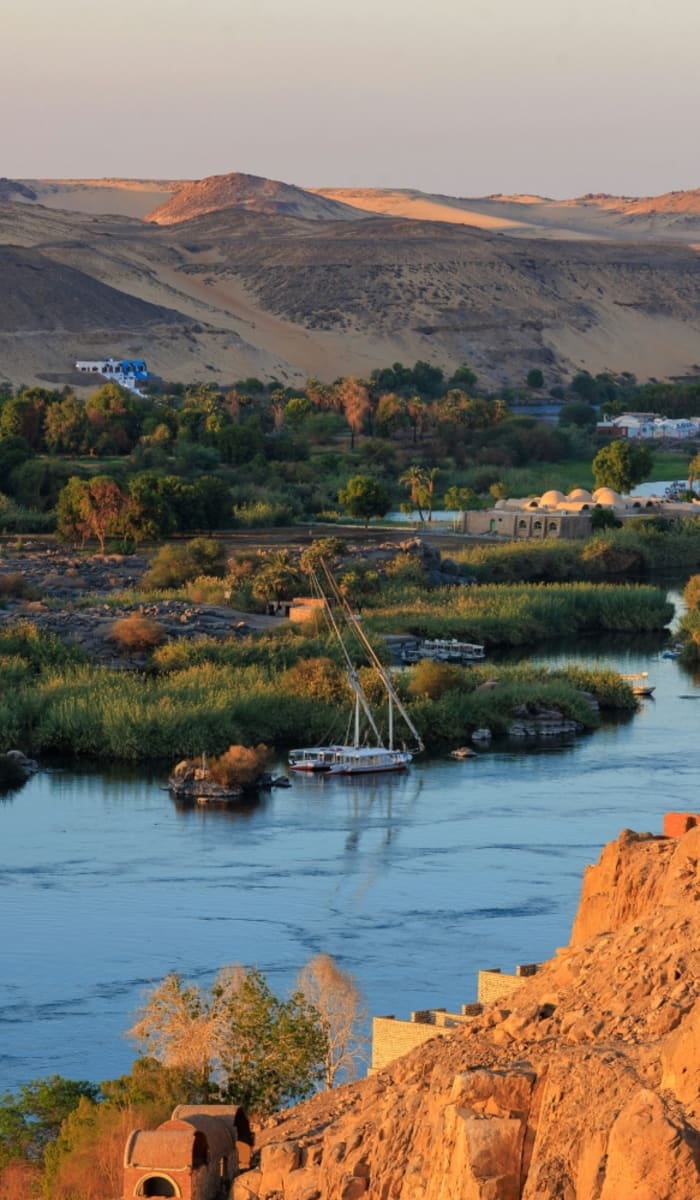
View over the river with boats and green banks, with desert hills in the background.
The route north of Luxor
Ships also travel on the Nile north of Luxor, but our six ships operate between Aswan and Luxor – Cairo is not on their route. At “ A journey through millennia ” the Nile part of the trip begins at the first cataract at Aswan and leads on board the ORO Luxury Dahabiya to Luxor.
By plane, it takes about 1 hour and 20 minutes to get from Cairo to the south. Alternatively, there is an overnight train – you board in Cairo in the evening and wake up in Upper Egypt in the morning.
Cairo and the south are about 1 hour and 20 minutes apart by scheduled flight, and there is also an overnight train.
Tombs and pyramids with special ticket
For the tomb of Seti I, the tomb of Nefertari, and the interior of the Cheops Pyramid, a separate ticket is required – the regular entry does not cover them. Upon request, we can book the tickets right away.
Round trips with Nile cruise
Two of our Egypt round trips combine land and river. After the first days on land, it goes on the water, and the days on the Nile form the heart of the journey.

on request
on request
Our ships at a glance
From the Nile Canopus to the MS Historia, each ship has a page with the cabin categories in detail.




Frequently asked questions about the Nile cruise
Which Nile cruise is the best?
The three dahabiyas and the three motor ships differ in the number of units, draft, and which stops they are allowed to visit. A ship that cannot dock in Gebel el-Silsila travels a different route between Luxor and Aswan than one that anchors there.
Dahabiya or motor ship?
The design alone does not indicate anything about the cabin area. Within the same shipping company, two motor ships in the standard category can differ significantly, and the dividing line is at the draft and the stops. El Kab is on both dahabiya routes, but on none of the large ship routes.
Does a dahabiya really sail?
The Nile Canopus sails under two large triangular sails, while the ORO Luxury Dahabiya has traditional sails.
How long does a Nile cruise take?
The trips last from 3 to 7 nights – the shortest goes in one direction, the longest returns as a round trip.
Which cabin location?
Total area and interior area are different for the suites: The Zahra shows its largest category with 115 sqm total and 50 sqm inside, and who only reads the larger number buys a terrace as a room.