


Aswan – Nile city at the first cataract
Temple islands and Nubia – the way to Abu Simbel
Temple islands and Nubia – the way to Abu Simbel
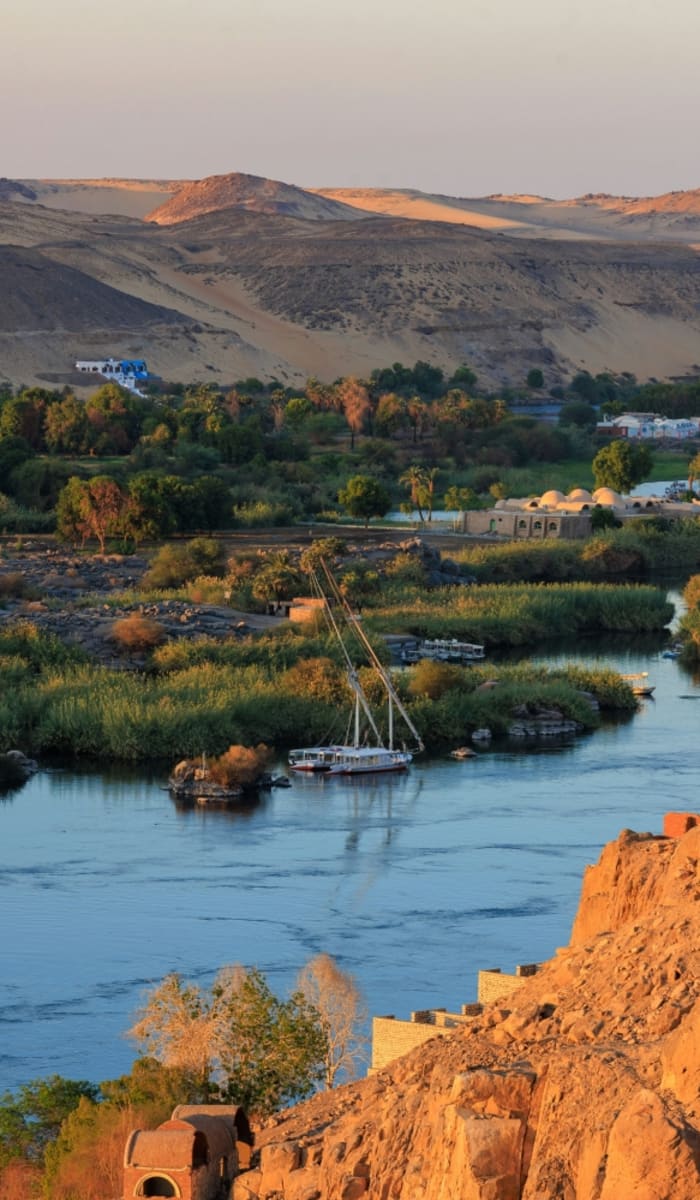
At the first cataract of the Nile, 879 railway kilometers south of Cairo, lies Aswan – for the Egyptian Ministry of Antiquities, the link between Egypt and Africa. The ancient Egyptians called the city Sunn. In front of it lie the islands of Elephantine and Agilkia, behind it begins the reservoir that has flooded the Nubian villages and part of their temples, extending into Sudan.
From Aswan, there are two ways to reach Abu Simbel, one by air and one by road through the desert.
The great monuments no longer stand where they were built. The construction of the Aswan High Dam threatened the monuments of the entire region, and a UNESCO campaign lasting over two decades moved temples and burial sites to higher ground – today they stand in Egypt on the World Heritage List.

Best travel time
Getting there and routes from Aswan
From Cairo, there are a scheduled flight and an overnight train to Aswan, from Aswan to Abu Simbel the flight and the road. The waterway is covered by the Nile cruises between Luxor and Aswan .
1# Scheduled flight from Cairo
Flight time 1 hour 20 minutes.
2# Overnight train from the north
Daily, overnight to Aswan – dinner and breakfast included.
3# Railway route
879 kilometers Cairo –Aswan.
4# Stay in Aswan
Twice for two nights in Aswan, once for one.
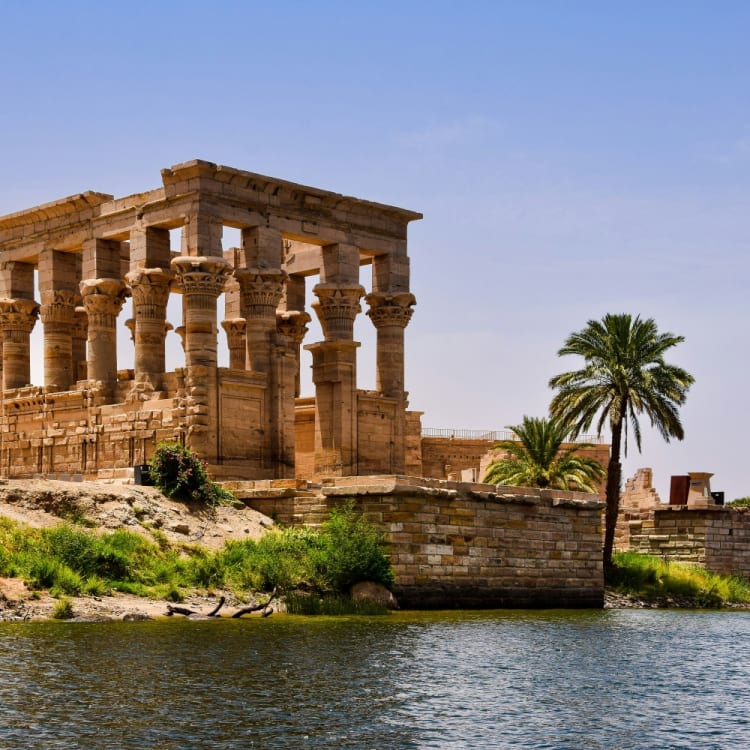
Aswan's temples – Philae on Agilkia
The temples of Philae no longer stand on Philae. The UNESCO Nubia campaign of the 1960s moved the monuments from the original island of Philae to the neighboring island of Agilkia because the reservoir permanently flooded the old island. The authority continues to refer to the site today as "Philae (Island of Agilkia)". According to the ministry, the temples can be reached by boat.
Several epochs built and modified at Philae sequentially. According to the authority, Ptolemy II Philadelphus (285–246 BC) began construction of the Isis Temple, the Hathor Temple was later executed by Ptolemy VI and Augustus, and the kiosk of Trajan dates from Roman times. The journey " Experience Egypt exclusively " includes two nights in Aswan.
The last hieroglyphic inscription of Egypt
On the island of Philae, pharaonic writing ends. The Isis Temple remained operational until the reign of Byzantine Emperor Justinian I (527–565 AD) according to the ministry. This emperor ordered the closure of all pagan temples in his empire, thus ending the cult on the island of Philae.
The last hieroglyphic inscription of Egypt is from an Isis priest named Esmet-Achom. It dates to the year 394 AD and marks the end of a writing tradition that had been continuously in use in Egypt for several millennia.
The Aswan High Dam and Lake Nasser
According to the State Information Service, the information organ of the Egyptian government, the Aswan High Dam has a crest length of 3,830 meters. The height of the structure is 111 meters, and it is built as a rock-fill dam and not as a concrete barrier.
In front of the structure, Lake Nasser backs up. The authority reports a length of 500 kilometers with an average width of twelve kilometers, and the lake covers the entire Egyptian Nubia according to their representation. It also covers part of Sudanese Nubia.
The construction itself stretched over several government agreements. The authority dates the beginning of the first construction phase to January 1960 and the inauguration to January eleven years later. In between, there was the diversion of the river and the first power from the power plant.
The temples of Abu Simbel
Abu Simbel in Egypt consists of two rock temples. The Ministry of Tourism and Antiquities attributes both to Ramses II of the 19th Dynasty and dates the work to around 1264 BC. The façade of the great temple features four colossal seated statues. The site is located far south of Aswan and its islands, on the banks of the reservoir.
The site belongs to a World Heritage Site with a long name. It is called "Nubian Monuments from Abu Simbel to Philae", lists ten individual monuments and has been on the UNESCO list since 1979. Abu Simbel is first on this list and gives the entire series its name. The other monuments of the series are distributed along the river upstream, to the first cataract at Aswan.
Inside Abu Simbel – the halls in the rock
The great temple stretches deep into the mountain. The sanctuary is about 60 meters away from the temple entrance, and there sit four figures side by side against the back wall of the hall. Three of them are Re-Horakhte, Amun-Re, and Ramses II himself. The fourth figure is the god Ptah, and he remains in shadow according to the orientation.
The relocation of Abu Simbel
The two temples now stand significantly higher than they were originally built. An international consortium led by the German company Hochtief sawed the complex into 1,036 individual blocks starting in 1964, each weighing between seven and thirty tons. The reconstruction took place 180 meters inland and about 64 meters higher.

Abu Simbel – access and solar wonder
On the route from Aswan, the flight time to Abu Simbel is 45 minutes – the second route goes by road through the desert.
For the solar wonder on February 22 and October 22, the ministry has its own rate, and the illumination inside lasts about 20 minutes. However, the event cannot be planned: the exact occurrence can only be accurately predicted within one to two days, and if there is dense cloud cover, the orientation does not take place.
Opening hours and access in Abu Simbel
The site in Abu Simbel opens early and closes in the late afternoon. The ministry states that the temples open from 6 AM to 5 PM on all seven days of the week.

Aswan's sights among the islands
The sights of Aswan are spread across the river and its islands. According to the ministry, Elephantine was "the gateway to Egypt for all merchants from Nubia", and on the island stands a Chnum temple, a Satet temple, a nilometer, and an island museum with finds from German excavations. The journey " A journey through millennia " includes one night in Aswan.
The World Heritage Site between Abu Simbel and Philae also includes sites in Aswan and its surroundings. The authority names them: the ancient granite quarries with the unfinished obelisk, the ruins of the ancient city of Elephantine, the Coptic Monastery of Simon, and the tombs of the Old and Middle Kingdoms. The further sites in the series lie south of it.
The unfinished obelisk of Aswan
The unfinished obelisk has never left the quarry. Once completed, according to the ministry, it would be about 42 meters high and weigh 1,168 tons, making it larger than any other ancient Egyptian obelisk. The commissioning was by Hatshepsut, and the stone was intended for the Amun temple. Work on it stopped because the granite showed cracks, and the block lay buried under the sand until the early twentieth century.
Aswan's botanical garden on Kitchener Island
The island in the river in front of Aswan has the official name El Nabatat. It is less than a kilometer long and is colloquially named after Lord Kitchener, who planted it with exotic trees, many of them from India. Access is by felucca from the southeast bank.
On the west bank opposite the island stands the mausoleum of the Aga Khan. Aga Khan III died in 1957, and the construction on the hill above the river took place around the time of his death.
The Nubian village near Aswan
Gharb Soheil is located on the west bank of the Nile, opposite Soheil Island and south of Aswan. The place is accessible by boat and is a resettlement community from the time after the dam's construction.
The Nubian Museum in Aswan
The Nubian Museum in Aswan opened in 1997, is clad externally with local sandstone and pink granite, and is spread over three floors. Its garden is designed as an open-air museum and contains part of a Fatimid cemetery as well as a cave with prehistoric rock inscriptions.
The Nubian Museum in Aswan opens daily from 9 AM to 5 PM, on Thursdays and Fridays additionally from 6 PM to 9 PM.
Three houses in Aswan
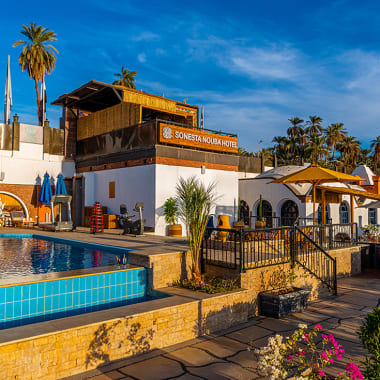
The three houses in Aswan are the Old Cataract above the first cataract, the BenBen on the Nubian island of Heissa, and the Sonesta Nouba on the Corniche.
The Sonesta Nouba in Aswan opened in April 2023 and features 45 rooms in traditional Nubian style, each with a private terrace and views of the Nile from every location.
The Old Cataract at the first cataract
The Old Cataract in Aswan stands on the rock above the river, overlooking the Nile and Elephantine Island. The operator describes the house as facing the Chnum temple on Elephantine and situated high above the river.
The operator of the Old Cataract in Aswan changed in May 2026, the Nile Wing will be renovated until July 2027, and the house will remain open during this time in the historic wing and thereafter will feature six dining establishments.

BenBen on Heissa Island
At the BenBen by Dhara , the operator lists ten out of eleven categories with square meters, from 23 to 95 square meters, and the view for each category. Two categories look out from the jacuzzi of their own terrace at the Philae temple, two others are Nubian in style and have the same view, one looks sideways at the river and the rocks of the island.
The house stands on the old Nubian island of Heissa in front of Aswan. Each room is, according to the operator, built of granite without cement, with cork floors and high wooden ceilings.

Nile cruise between Luxor and Aswan
Two trips of this house include Aswan as a separate stage in the itinerary. The fourteen-day trip includes 2 nights and firmly includes Abu Simbel in the program, the shorter trip includes 1 night and Abu Simbel only as an express option. Which sites are included in which of the two trips is outlined in the itinerary of the respective trip.

on request
on request
Hotels in Aswan
Three houses in Aswan are available for selection, from the historic house above the first cataract to the house on the Nubian island of Heissa in front of Aswan.


Frequently asked questions about Aswan and Abu Simbel
When was Abu Simbel relocated?
The authority states that the year was 1968. The reason was the dam, which threatened to flood the two temples, and the complex has since stood higher and further inland.
Where are Aswan and Abu Simbel located?
Aswan is located at the first cataract of the Nile, in the south of Egypt. Abu Simbel is located, according to the ministry, about 300 kilometers south of Aswan, on the banks of the reservoir.
What is Abu Simbel?
Abu Simbel consists of two rock temples. Ramses II had them carved there according to the ministry, and the façade of the great temple features four colossal seated statues of the king himself. The site is now part of a World Heritage site consisting of ten Nubian monuments between Abu Simbel and Philae.
Is Abu Simbel worth it?
According to schedule, the day trip departs from Aswan by flight. The site opens early and closes in the late afternoon, on all days of the week, and the flight from Aswan fits within this framework. The road trip is also possible.
How do you get from Cairo to Aswan?
From Cairo, there are air and rail routes south, and the overnight train runs daily overnight to Aswan.
Can you safely see the solar wonder in Abu Simbel?
No – the exact occurrence of the solar wonder in Abu Simbel can only be accurately predicted within one to two days, and if there is dense cloud cover, the orientation does not take place.