



Aswan – Nile city at the first cataract
Temple islands and Nubia – the way to Abu Simbel
Temple islands and Nubia – the way to Abu Simbel
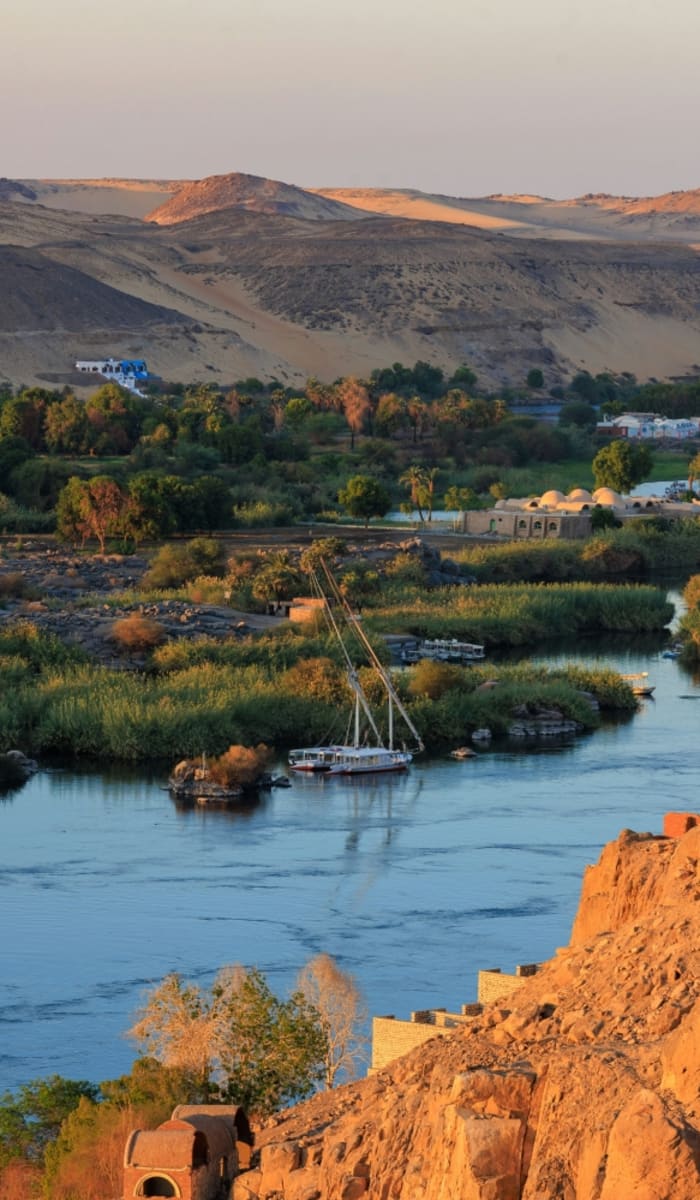
At the first cataract of the Nile, 879 railway kilometers south of Cairo, lies Aswan – for the Egyptian Ministry of Antiquities the link between Egypt and Africa. The ancient Egyptians called the city Sunn. In front of it lie the islands of Elephantine and Agilkia, behind it begins the reservoir that has flooded the Nubian villages and part of their temples, extending into Sudan.
There are two ways to Abu Simbel from here, one by air and one by road. The flight schedule lists 13 flights per week, as of September 2026, and the actual flight time is 45 minutes – all departures are in the morning, all return flights until early afternoon. The road runs through the desert, and no authority issues its convoy status today.
The large monuments are no longer where they were built. The construction of the dam threatened the monuments of the entire region, and a campaign by UNESCO lasting over two decades brought temples and burial sites to higher ground – since 1979 they have been on the UNESCO World Heritage List . This page organizes what can be accessed from Aswan and notes where sources yield no information.

Best travel time
Arrival and routes from Aswan
The information in this box pertains to long-distance connections from Aswan, not the routes within the city area. The flight schedule comes from an aggregator and not from the companies themselves, which is why there is a cutoff date behind each frequency, here as of September 2026. The route over water does not belong here – it is listed under the Nile cruises between Luxor and Aswan .
1# Flight to Abu Simbel
13 flights per week, as of September 16, 2026, averaging around two daily – flight time 45 minutes, operated by EgyptAir and Air Cairo.
2# Departure times
to between 06:55 and 13:15, back between 08:20 and 14:30, return flight 40 minutes – no afternoon flight in.
3# Distance to Abu Simbel
Flight distance 214 kilometers, the ministry ranks the temples about 300 kilometers south of Aswan.
4# Scheduled flight from Cairo
41 flights per week, as of September 16, 2026, averaging around six daily – flight time 1 hour 20 minutes, first departure 04:00, last 23:20, five specifically named airlines.
5# Night train from the north
Operator since 2023 Abela Trains, departure not from Ramses but from Bashtil station, all trains stop in Giza – daily trains operate 82, 83, 86, and 87.
6# Schedule example
Train 82 departs at 21:10, arrives in Aswan at 11:10, Train 87 departs from Aswan at 17:15, arrives in Giza at 06:05 – dinner and breakfast included in the fare.
7# Railway line
879 kilometers Cairo –Aswan.
8# Rapid transit under construction
second line from October City to Aswan and Abu Simbel, 1,100 kilometers, 36 stations, section Aswan–Luxor 210 kilometers, maintenance depots in Aswan, Abu Simbel, and Safaga – no commissioning date is mentioned in the report.
9# Aswan in the program
Aswan is a separate stage in two tours of the house – once two nights, once one.
Aswan's temples – Philae on Agilkia
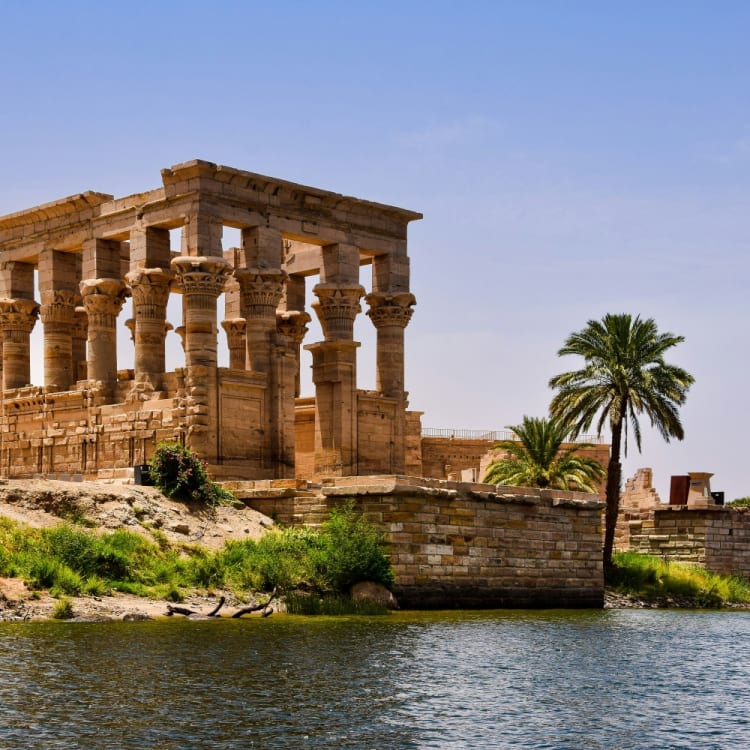
The temples of Philae are no longer on Philae. The UNESCO Nubian campaign of the 1960s moved the monuments from the original island of Philae to the neighboring island of Agilkia, as the reservoir permanently flooded the old island. Thus, the authority still refers to the site as "Philae (Island of Agilkia)", and the new island stands as such in the official World Heritage name. According to the same ministry, the temples are accessible by boat.
Several epochs built and modified at Philae. According to the authority, the construction of the Isis Temple began under Ptolemy II Philadelphus (285–246 BC), the Hathor Temple was later executed by Ptolemy VI and Augustus, and the kiosk of Trajan dates from Roman times. The journey Experience Egypt exclusively allocates two nights in Aswan and explicitly includes the Philae Temple in the stage text. Abu Simbel is firmly included in its program, while in the other trip with an Aswan stage it is an option.
There is no reliable information for the boat transfer to Agilkia. Neither an authority nor an operator mentions a dock, waiting time, or a quota, and also for the sound and light show at Philae, there are no sources providing time, language, or process. A commercial site states "three times per night" but leaves everything else open. Therefore, those planning the journey to Agilkia must clarify it with the executing agent and not with a published source.
The last hieroglyphic inscription of Egypt
On the island of Philae, pharaonic writing ends. According to the ministry, the Isis Temple remained in operation until the reign of the Byzantine Emperor Justinian I (527–565 AD). This emperor ordered the closure of all pagan temples in his realm, and thus, the cult on the island of Philae came to an end.
The last hieroglyphic inscription of Egypt comes from an Isis priest named Esmet-Achom. It dates back to the year 394 AD and thus stands at the end of a writing tradition that was continuously in use in Egypt for several millennia. This singular fact is reported for this site by the Ministry of Tourism and Antiquities itself and not by the later interpretation of a third party.
The Aswan Dam and Lake Nasser
There is an official primary source with complete metrics for the Aswan Dam. The State Information Service, the information organ of the Egyptian government, states a crown length of 3,830 meters, of which only 520 meters lie between the two banks of the Nile – the rest spreads over two wings at the shores. The height of the structure amounts to 111 meters according to the same source. The same place describes it as an embankment dam and not as a concrete barrier.
On the German web, a different figure stands at the same point. Two commercial sites among the top ranks state a length of 3,600 meters, a third speaks of "just under four kilometers" – neither provides a source for their value. The deviation from the official value is 230 meters, a little over six percent, and quite ironically, the site with the official value ranks at the very top. Of the three precise values on the German web, only one agrees with the authority.
Before the structure, Lake Nasser is dammed up. The authority states a length of 500 kilometers with an average width of twelve kilometers for it, and the lake covers all of Egyptian Nubia according to their depiction. It also covers part of Sudanese Nubia, and six tunnels conduct the water from the reservoir to the turbines of the power plant. Storage volume, the dam target, and annual output are provided separately by the same authority source.
The construction itself stretched out over several government agreements. The authority dates the start of the first construction phase to January 1960 and the inauguration to January eleven years later, with the river diversion and the first electricity from the power plant in between. A Soviet loan agreement, the withdrawal of the World Bank, and an international inspection commission preceded the actual start of construction by years. This chronology also comes from the State Information Service itself.
The authority publishes nothing that would make a visit planable. For the Aswan Dam, the State Information Service provides neither opening hours nor an entrance fee nor a rule for access. None of the three reviewed commercial sites provides such visitor information, although all three describe the structure in detail across several screen pages. This site therefore does not provide a visitor declaration and explicitly names the gap instead.
The temples of Abu Simbel
Abu Simbel in Egypt consists of two temples carved into the rock. The Ministry of Tourism and Antiquities attributes both to Ramses II of the 19th Dynasty and dates the work to around 1264 BC. The facade of the large temple features four colossal seated statues, which the authority describes in its own wording as enthroned colossi. The complex lies far south of Aswan and its islands, on the banks of the reservoir.
The site belongs to a UNESCO World Heritage Site with a long name. It is called "Nubian Monuments from Abu Simbel to Philae", includes ten individual monuments, and has been on the UNESCO list since 1979. Abu Simbel is the first on this list and gives the entire series its name. The other monuments in the series are spread along the course of the river to the north, up to the first cataract at Aswan.
Abu Simbel inside – the halls in the rock
The large temple extends deep into the mountain. According to the expert source, whose author was involved in the surveying work in Abu Simbel, the sanctuary is located about 60 meters from the temple entrance, and four figures sit side by side against the back wall of the hall. Three of them are Re-Horakhte, Amun-Re, and Ramses II himself. The fourth figure is the god Ptah, and he remains in the shadow during the orientation.
The documentation ends precisely at this point for the interior. Neither the Ministry of Tourism and Antiquities nor any other verified source provides information on visitor quotas, photography rules, or access outside of opening hours in Abu Simbel. What is stated in the market comes from no verifiable source. This site claims nothing on this and refers to the executing agent for clarification.
The relocation of Abu Simbel
The two temples now stand significantly higher than they were originally built. According to the ministry, they were relocated in 1968, after the dam threatened to flood them at their old location. An international consortium led by the German company Hochtief sawed the complex into 1,036 individual blocks starting in 1964, each weighing between seven and thirty tons.
The number of blocks and the tonnage range come from an encyclopedic source, not from the authority. The reconstruction took place 180 meters inland and about 64 meters higher – the expert involved in the surveying work indicates one meter more for the height of the relocation, and none of the two values is considered secured here. The temples were saved by a UNESCO campaign that lasted two decades and involved several states.

Abu Simbel – Arrival, convoy, and solar wonder
Of the two routes, only one is listed in a published schedule. On the route from Aswan, there are 13 flights per week, as of September 2026, averaging around two a day, and the flight time is 45 minutes. All departures are in the morning, all return flights until early afternoon. There is no afternoon flight south, and thus the entire day's planning follows.
The market calculates differently at this point. One provider from the investigated comparison field mentions a half-hour flight to Abu Simbel, a second rounds up to just under half an hour – thus, about a third of the flight time is missing from the measured value. Those planning their itinerary from Aswan at half an hour are scheduling too tightly. The flight schedule is the stricter and the verifiable data.
For the convoy, no authority issues anything this year. The word does not occur anywhere on the website of the Foreign Office, and four Egyptian authorities were specifically searched for it. The provider pages fall apart: one states that the police convoy is no longer mandatory and describes checkpoints and voluntary departures in the same text, while others continue to describe it in the present tense. The circulating departure times contradict each other, and thus this site provides none of them.
The solar wonder has been dated by the authority itself. The ministry lists its own fee for February 22 and October 22 and thus places the event in its own fee schedule, not in a narrative from a third party. The internal lighting lasts about 20 minutes, according to an encyclopedic source. This is the entire time span relevant for these two days of the year.
The event is therefore still not plannable. On February 22, 2025, around 4,000 foreign and Egyptian visitors waited before sunrise, and the orientation did not take place due to dense clouds that morning. The expert source also explains why a calendar is of little help here: The exact occurrence can only be predicted to within one or two days. A shift in dates due to the relocation of the temples is astronomically excluded.
Opening hours and access in Abu Simbel
The site in Abu Simbel opens early and closes in the late afternoon. The ministry states for the temples an opening time from 6 AM to 5 PM on all seven days of the week. The same authority does not specify a summer or winter time for the site, nor a separately marked last entry for the ticket offices.
A reliable product for access before this opening does not exist in the entire surveyed market. What is sold as sunrise in Abu Simbel is, according to the survey, nothing more than the arrival at the regular opening of the site. The difference between both lies solely in the permission, and so far, no one has verified this on this market.

Verified and open statements
What we can verify — and what we cannot
The opening hours and all dates from this site come from the Egyptian Ministry of Tourism and Antiquities. The metrics for the large structure at the cataract come from the State Information Service, the information about the three houses from the operators themselves, and the market findings from an independent survey. Where one of these sources yields no information, a written notice of absence is stated here.
A claim would otherwise stand on this site unchallenged. For the convoy to Abu Simbel, no authority provides any information this year – neither the Foreign Office, whose website has no mention of it, nor any of the verified Egyptian authorities. The only dated cancellation notice from the entire survey is a blog article from October 17, 2016. Therefore, we do not write that the convoy has been abolished.
Two more notices of absence concern the numbers themselves. The flight schedule can only be verified through an aggregator because the sites of EgyptAir and Air Cairo block automated calls, which is why each frequency on this site carries a cutoff date. No authority publishes an opening time, entrance fee, or rule for access for the large structure at the cataract.
Information researched in September 2026.
Aswan's attractions between the islands
The attractions of Aswan are distributed along the river and its islands. According to the ministry, Elephantine was "the gateway to Egypt for all traders from Nubia," and on the island stand a Chnum temple, a Satet temple, a nilometer, and an island museum with finds from German excavations. Since 1979, Elephantine has also been part of the World Heritage. The journey A journey through millennia includes the island in its stage text and allocates one night in Aswan.
The World Heritage Site between Abu Simbel and Philae also includes sites in Aswan and its surroundings. The authority names them: the ancient granite quarries with the unfinished obelisk, the ruins of the ancient city of Elephantine, the Coptic Monastery of Simeon, and the tombs of the Old and Middle Kingdoms. The other sites in the series lie south of this. The authority does not mention any specific figure for the Aswan share in any of its overview.
The unfinished obelisk of Aswan
The unfinished obelisk has never left the quarry. It would have measured about 42 meters high and weighed 1,168 tons and thus would be larger than any other ancient Egyptian obelisk. The client was Hatshepsut, the stone was intended for the Amun temple. Work on it was halted because the granite showed cracks, and the block lay buried under the sand until the early twentieth century.
Aswan's botanical garden on Kitchener Island
The island in the river is officially named El Nabatat. It is less than one kilometer long and is colloquially named after Lord Kitchener, who planted it with exotic trees, many of them from India. Access is via felucca from the southeastern riverbank. The Aswan overview of the ministry does not list the island, and the circulating area figures differ by more than double – hence there is no area figure listed here.
On the west bank opposite the island stands the mausoleum of the Aga Khan. Aga Khan III died in 1957, and the building on the hill above the river was constructed around the time of his death. There is no official information on access to the Aga Khan mausoleum, neither regarding an opening time nor the interior of the structure. Planning it firmly into a program carries a risk.
The Nubian village near Aswan
Gharb Soheil lies on the west bank of the Nile, opposite the island of Soheil and south of Aswan. The place is accessible by boat and is a resettlement community from the time after the dam was built. There is no official source for it – all hits are from organizer, intermediary, or blog pages. What would be stated on this page about the village itself would be copied from a third party and not verified.
The Nubian Museum in Aswan
Verified is the state house with the Nubian collection. The Nubian Museum in Aswan opened in 1997, is clad outside with local sandstone and pink granite, and spans three floors. Its garden is designed as an open-air museum and includes part of a Fatimid cemetery as well as a cave with prehistoric rock inscriptions. Sandstone, granite, floor count, and garden are stated as such in the ministry's description.
The actual planning factor of this house is its opening hours. The house opens daily from 9 AM to 5 PM and additionally on Thursdays and Fridays from 6 PM to 9 PM – according to the published times, the only officially designated evening time window in the region. Regarding the collection itself, the authority only states "thousands of objects" and does not mention a figure anywhere. Thus, no object count is provided on this page either.
Three houses in Aswan
Three houses in Aswan belong to this house's own inventory. They are the Old Cataract above the first cataract, the BenBen on the Nubian island of Heissa, and the Sonesta Nouba on the corniche. Only BenBen provides category names with square meters, while the other two houses have a written notice of absence instead of an estimate on this page. Estimated areas would not constitute information but rather a claim.
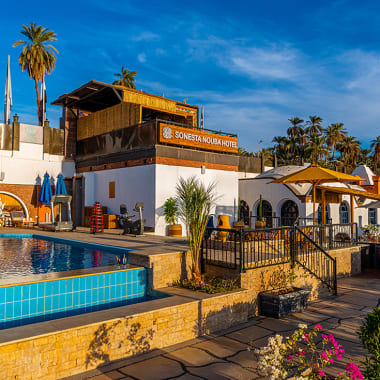
The Sonesta Nouba features 45 rooms in traditional Nubian style, each with a private terrace and a Nile view from every position. The house opened in April 2023, as confirmed by the operator's press release. Square meters and category names are not provided anywhere by the operator, neither on their own hotel page nor in this announcement.
The Old Cataract at the first cataract
The Old Cataract stands on the rock above the river, overlooking the Nile and the island of Elephantine. The operator describes the house as oriented toward the Chnum temple on Elephantine and situated high above the river. It is also the only Aswan house in the inventory that is listed as a designated stage hotel in both tours with an Aswan stage in the itinerary.
The operator changed in May 2026, and the press release about this is dated to February of the same year. The Nile Wing will be renovated until July 2027; the house will remain open in the historical wing during this time and will have six restaurants afterward. However, neither the old nor the new operator provides a number of rooms, a category, or an area, which is why none of these three details are listed here.

BenBen on Heissa Island
The BenBen by Dhara is the best equipped case among the three houses. The operator lists ten out of eleven categories with square meters ranging from 23 to 95 square meters, along with the view for each category. Two categories overlook the Philae Temple from the jacuzzi of their own terrace, two more are designed in Nubian style and have the same view, one has a side view of the river and the rocks of the island.
The house is located on the old Nubian island of Heissa in front of Aswan. According to the operator, each room is built from granite without cement, featuring cork floors and high wooden ceilings. Eleven categories do not mean eleven rooms, and the operator does not specify a total number of rooms for the house anywhere on his own page. He also does not indicate an age limit for guests.

Nile cruise between Luxor and Aswan
Two trips of this house include Aswan as its own stage in the travel itinerary. The two-week trip includes 2 nights and firmly features Abu Simbel in the program, while the shorter trip includes 1 night and Abu Simbel only as an explicit option. The specific sites included in each of the two trips are detailed in the itinerary of the respective journey.

on request
on request
Hotels in Aswan
Three houses in Aswan are available here for selection, from the historic house above the first cataract to the house on the Nubian island of Heissa. Categories, amenities, and conditions for each house are available one click deeper on the respective house's own page. Two of the three houses are currently not included in any travel itinerary of the inventory, and this page incorporates them for the first time.


Frequently Asked Questions about Aswan and Abu Simbel
When was Abu Simbel relocated?
The authority cites the year 1968 for this. The blocks were already being cut from 1964, led by a German company and commissioned by an international UNESCO campaign. The reason was the dam, which threatened to flood the two temples, and since then the site is at a higher and more inland location. No cost information is provided here intentionally, as the two circulating amounts differ widely and both lack a verifiable source.
Where are Aswan and Abu Simbel located?
Aswan is located at the first cataract of the Nile, in the south of Egypt. By rail, it is 879 kilometers from Cairo southward, and that is the only distance for which this route has a cited source. According to the ministry, Abu Simbel is located about 300 kilometers further south, on the shore of the reservoir. A travel time in minutes is intentionally not provided here, as the circulating figures contradict each other and lack a primary source.
What is Abu Simbel?
Abu Simbel consists of two rock temples carved into the native rock. Ramses II from the 19th dynasty had them carved into the rock around 1264 BC according to the ministry, and the facade of the great temple features four colossal seated statues of the king himself. The site is now part of a World Heritage site comprising ten Nubian monuments between Abu Simbel and Philae.
Is Abu Simbel worth it?
The day trip is scheduled to take place. There are 13 flights per week from Aswan to Abu Simbel, as of September 2026, with a flight time of 45 minutes, and all departures are in the morning. The site itself opens from 6 AM to 5 PM on all weekdays, making the day trip by flight feasible according to schedule. The road route is also possible, but its convoy status is not indicated by any authority and needs clarification with the executing agent before booking.
How do you get from Cairo to Aswan?
From Cairo, air travel and rail lead south. The flight schedule includes 41 scheduled flights per week as of September 2026, operated by several specifically named airlines. The night train from Abela Trains departs daily from Bashtil station and not from Ramses, and the railway distance to there measures 879 kilometers. A second high-speed line to Aswan and Abu Simbel is under construction, but the authority does not specify an operational date in its announcement.
Can you safely see the sun miracle in Abu Simbel?
No. The authority dates the event according to its own fee schedule to February 22 and October 22, and the lighting inside lasts about 20 minutes. The exact occurrence can only be predicted with a precision of one to two days according to the expert source. On February 22, 2025, about 4,000 foreign and Egyptian visitors waited in vain because the alignment did not take place due to dense cloud cover. There is no reliable visibility percentage for the event.


