



Luxury Nile Cruise
Six ships on the Nile – from 9 to 44 cabins and suites
Six ships on the Nile – from 9 to 44 cabins and suites
The route on which a luxury Nile cruise operates lies between Luxor and the first cataract – the same route that the rest of the country's river fleet traverses. The Egyptian Ministry of Tourism counts 237 licensed floating hotels nationwide, of which 180 are in operation, while the others are undergoing renovation. Six of them are displayed side by side in this overview.
The range of this selection is broader than the common term suggests. For some, a Nile cruise in Egypt means a motorboat with 44 units, while for others it means a dahabiya with 9 cabins and suites. Everything that the German market offers falls in between, and the two ends are separated by more than just the number of cabins.
This page belongs to the trips that Orient Memories compiles in Egypt , and it arranges the six ships according to the same columns. Where an operator does not publish a detail, it is also stated here. The cruise is part of a trip through Egypt and not a standalone product.

Best travel time
Nile Cruise – comparison of six ships
The six ships of this Nile cruise consist of three dahabiyas and three motorboats on the same route on the Nile. The smallest unit has nine cabins and suites, the largest forty-four – in between, the types of construction differ in draft, number of guests, and holding rights. The selection is not a market overview as it specifically shows the six Nile ships that this company has in its program. Two of them are part of a trip itinerary, while the remaining four are presented as individual ship pages without a related trip.
Ten columns compare the same features, and five of them remain empty for multiple ships. The specified lengths range from 50 m to 72 m, while three ships carry none at all – not a single one of the six operators indicates a year of construction, and four do not publish square meter figures. The column 'Type of Construction' is a classification for this page and not an operator detail, since four of the six operators do not specify any propulsion. Where a detail is missing, 'not specified' is stated and no estimation.
| Ship | Cabins and suites | Cabin area | Year of construction | Length | Draft | Route and duration | Type of construction | Propulsion | For whom |
|---|---|---|---|---|---|---|---|---|---|
| Nile Canopus | Cabins and suites: 10, including 4 suites | Cabin area: not specified | Year of construction: not specified; style of the 1920s | Length: 55 m | Draft: not specified; the operator only states 'shallow draft' | Route and duration: Luxor–Aswan, 3 or 4 nights in both directions, 7 nights as a round trip | Type of construction: dahabiya | Propulsion: two large triangular sails; what happens in calm winds is not specified | For whom: the only ship in the selection with the named anchorage Bessaw |
| ORO Luxury Dahabiya | Cabins and suites: 9 units – 1 master suite, 2 junior suites, 6 luxury rooms; maximum 18 guests | Cabin area: not specified | Year of construction: not specified | Length: 50 m, width 7.5 m | Draft: 0.8 m | Route and duration: Aswan–Luxor 4 nights, in the opposite direction 5 nights | Type of construction: dahabiya | Propulsion: traditional sails, travel speed 4 to 5 knots | For whom: smallest number of units and lowest specified draft of the six; the only ship in the selection that visits Gebel el-Silsila |
| The Oberoi Zahra | Cabins and suites: 28 | Cabin area: Luxury Cabin 26.4 sqm; Luxury Suite 115 sqm total and 50 sqm inside; Suite with two bedrooms 92 sqm | Year of construction: not specified | Length: not specified | Draft: not specified | Route and duration: Aswan and Luxor in both directions, 3, 4, and 7 nights, plus a variant at low water levels; departures on Tuesdays and Saturdays | Type of construction: motorboat | Propulsion: not specified | For whom: largest specified suite area of the six with 115 sqm total |
| The Oberoi Philae | Cabins and suites: 22 | Cabin area: Luxury Cabin 36 sqm; Luxury Suite 55 sqm; Suite with terrace 85 sqm total and 55 sqm inside | Year of construction: not specified | Length: not specified | Draft: not specified | Route and duration: Aswan and Luxor in both directions, 4 nights and 6 nights, plus a variant at low water levels; departures on Tuesdays and Saturdays | Type of construction: motorboat | Propulsion: not specified | For whom: largest standard cabin in comparison with 36 sqm; own dock with access for guests with mobility restrictions |
| Cleo | Cabins and suites: 10 – 2 panorama deluxe suites with balcony, 4 double cabins, 4 twin cabins | Cabin area: not specified | Year of construction: not specified | Length: not specified | Draft: not specified | Route and duration: from Luxor towards Aswan; nights and stops not specified | Type of construction: dahabiya | Propulsion: not specified | For whom: not specified |
| MS Historia | Cabins and suites: 44 – 32 cabins and 12 suites; 88 guests, 40 crew | Cabin area: not specified | Year of construction: not specified | Length: 72 m, 5 decks, 310 to 320 t | Draft: 1.40 m | Route and duration: Luxor and Aswan in both directions, 3, 4, or 7 nights; stops not specified | Type of construction: motorboat | Propulsion: not specified; travel speed 15 to 20 km/h | For whom: largest number of units and most onboard infrastructure of the six; at the same time the deepest draft |
Two columns separate the ships more sharply than the number of cabins. The draft ranges from 80 cm for the shallowest dahabiya to 140 cm for the largest motorboat, and this determines which anchorages are even accessible. The second column is the cabin area, and there it shows The Oberoi Philae as the largest standard category of the comparison.
Fleet and route in numbers
The following spans refer to the 6 ships on this page and not to the fleet of the country. Where a value only applies to part of them, it states how many operators specify it and how many leave the detail open. The values come from the operators' websites where available, and otherwise from the company's own database.
1# Ships in comparison
six, including three dahabiyas and three motorboats
2# Units per ship
9 to 44 cabins and suites
3# Draft
0.8 m to 1.40 m; only two of the six operators specify it
4# Ship length
50 m to 72 m; not specified for three ships
5# Trip duration
3 to 7 nights
6# Fixed departure days
Tuesdays and Saturdays for both Oberoi ships; the remaining four do not specify a fixed day
7# Season
October to April on all six Egypt trips of the house
Booked and open ship data
What we can confirm — and what we cannot
Three numerical discrepancies could be resolved without inquiry, and all three go against the available inventory. The Oberoi Zahra currently has 28 cabins and suites, while older information – including the hotel's own websites – states 27, and the MS Historia counts 44 units instead of the approximately 40 mentioned there. For the Philae, the circulating cabin sizes originated from the sister ship, and the operator's website clearly distinguishes between both ships.
Other information remains open, and it is stated as such. Not a single one of the six operators mentions a year of construction, and four ships do not provide any square meter information – for the Nile Canopus, the ORO Luxury Dahabiya, the Cleo Dahabeya and the MS Historia. Only two of the six operators specify a draft, leaving it open for the other four which shores they can reach.
In the German internet, the number of around 300 Nile ships circulates. It does not match the 237 licensed units of the ministry nor the approximately 100 floating hotels that an Egyptian industry committee states for the route itself – a committee is not an authority, and this limitation is part of the number. None of the two sources citing the higher number provide a source for it.
Data researched in September 2026.
Small ship or motor vessel
Those looking for a small ship do not choose against comfort but against capacity. The own guide inventory classifies the categories at 50 to 70 cabins for the large ship and six to twelve cabins for the Dahabiya, while the ships in this selection cover both ends. Both classes travel the same route between Luxor and Aswan.
The first criterion is the draft, not the number of cabins. The ORO Luxury Dahabiya lies shallower in the water than any other ship in this selection that specifies its draft at all – what implications follow from that is not stated by either source. The number of cabins says just as little about it, as two ships with the same occupancy can lie completely differently deep in the water.
The second criterion is the docking rights at the shore. Two operators independently state that large cruise ships may not dock in Gebel el-Silsila, while the MS Historia with 88 guests on board does not even indicate this stop. No one states why the rule exists.
The third criterion regularly leads to errors. Within the Nour El Nil fleet, the categories range from 14.75 sqm to 29.50 sqm, while the sister ship of the same shipping company is even below that – the design form says nothing about the area. It is no different for the two motor ships of the same brand.
A fourth criterion is rarely mentioned in a brochure. Both motor ships of the Oberoi shipping company offer a special route variant for low water levels, and one of them advertises a private landing stage that provides access for guests with mobility restrictions. Fixed departure days are on Tuesdays and Saturdays, while the other four ships have no designated days at all.
The last criterion is the duration of the trip. One operator in the field specifies a minimum duration of three nights, but no one names a minimum number of people – those who only travel for 3 nights see the route in one direction. The selection is determined by these five points and not by the design form.
Dahabiya under sail
A Dahabiya – written Dahabieh by some houses, by others like the Cleo Dahabeya with a different ending – is a sailing ship without its own propulsion, and in the German comparison field, no single page verifies this attribution. Three of the six ships in this selection are Dahabiyas. What actually drives them is stated on two operator pages and not on one.
The Nile Canopus sails under two large triangular sails, as stated by Relais & Châteaux. The operator mentions a low draft without specifying it, and describes the ship as gliding silently – he does not provide a figure for the draft. The information about the sail is quoted there, while the question of the behavior in the absence of wind remains open on the same page.
The ORO Luxury Dahabiya carries traditional sails and specifies a travel speed of 4 to 5 knots. This is the only speed indication among the three Dahabiyas in this selection, and it fits a hull that lies shallower than any other in comparison. In contrast, for the Cleo Dahabeya, there is no information on propulsion – the operator's page only states the departure from Luxor and not a word about engine, generator or accompanying boat.
In the market, other details read much sharper. A German operator speaks of "sail or tow propulsion (in the absence of wind)", for the Sonesta Amirat an intermediary specifies an accompanying boat that tows in calm conditions, and Djed conversely advertises "no engine aboard". Two of the three sources expressly state what happens in calm, while the third merely excludes an engine on board.
At exactly this point ends the verifiable part. Neither Relais & Châteaux nor the operator's page of the ORO states what happens in still wind, and none of the three excludes an accompanying boat – "Sails available" is not the same as "travels under sail". Those who need this assurance should inquire about it before booking.

A traditional sailboat under a large triangular sail, with palms and a city in the background.
Routes and anchorages on the Nile
The design form determines where the ship may anchor at all. Large cruise ships may not dock in Gebel el-Silsila, and El Kab lies on both elevated Dahabiya routes, on none of a motor ship's route. Why this is the case is not written by either operator – Esna delineates the worlds even more clearly.
The anchorages of the small ships carry names that hardly appear in the German internet: the island of Quessia, Wadi el Shat, the island of Maniha, El Fawaza, the Nubian village of El Koubania, and the market of Daraw. Bessaw appears exactly once in the entire survey, namely with the Nile Canopus. No motor ship in the selection specifies any of these stops, and the large ships’ route lists do not mention the names at any point.
Esna stands for both classes, but not in the same way. The Dahabiyas start there and walk to the Chnum temple and the souk, while the motor vessels pass the lock and continue – the same location mark, two different days. The motor vessels traverse the same series from Kom Ombo, Edfu, and Esna, and one of them additionally specifies Dendera and Abydos.
Two of the six operators do not specify their stops at all. For the Cleo Dahabeya, only the direction from Luxor is given, while the MS Historia's operator page refers to a selection of routes without naming a location – whether it stops at one of the anchorages remains open. Exactly one of the six ships mentions Gebel el-Silsila.
The own cruise lies in both cases between the first cataract and Luxor. " Experience Egypt exclusively " it lists as stage 3 with 4 nights on the Nile Canopus, and the trip goes downstream, with stops in Kom Ombo and Edfu. Those who want to see the smaller anchorages need a ship that can dock there at all.

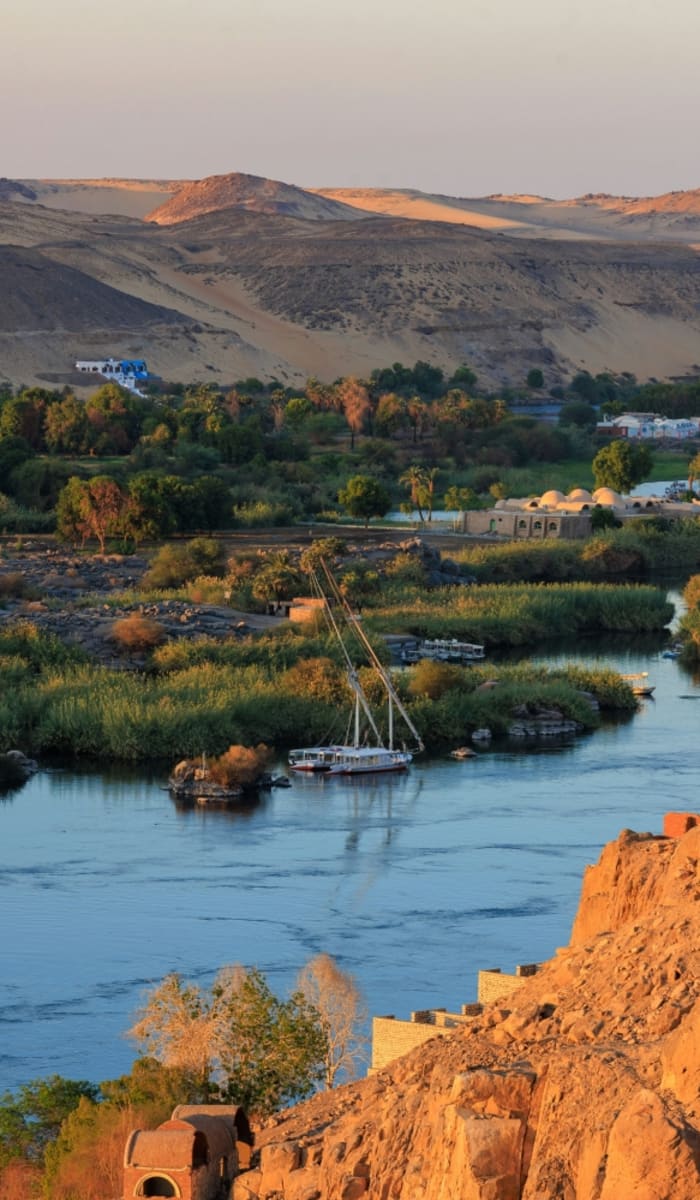
View over the river with boats, green banks, and desert hills behind.
The route north of Luxor
North of Luxor, ships operate, just not these six. The Egyptian Minister of Tourism explicitly counts the licensed units, including those servicing the long trips between Cairo and the south, and this route is listed in the German market with 14 nights in the program. The long-distance route uses partly another fleet, partly the same ship on a different route.
The bottleneck is not at Esna, 60 km south of Luxor. The limiting point is the Assiut lock, along with the bridges at Sohag and Nag Hammadi – so describes it an Egyptian travel provider, not an authority. The dam inaugurated there in 2018 has two chambers of 156 m length each, although the MS Historia measures only 72 m and thus fits well. What size actually limits the route remains unverified.
There is no product for this route here. The own cruise is in both journeys the stage between the first cataract and Luxor – in " A journey through millennia " as the third stage on the ORO Luxury Dahabiya. Those who want to travel by water from Cairo find this with other providers offering eleven nights and up to twelve stops. This is mentioned because the search query assumes an offer that hardly exists.
The journey answers the question in a much more practical way. Cairo and the south are 1 hour and 20 minutes apart by scheduled flight, with 48 connections per week, and a night train has been running since October 2024 from the Bashtil station in Giza. Which mode of transport is used for a journey is stated in the respective travel itinerary and not here.
Included services on board and on land
The scope of services does not follow the price level of the offer. In the investigated comparison field, the most expensive offer excludes tips, additional drinks on board, the balloon ride, and the flight to Abu Simbel, while the cheapest includes tips on board and during excursions. This order cannot be derived from the offer, and those who only look at the layout of a list of services compare two different things.
The sharpest indication appears with the beverages. One provider specifies its service as 2 bottles of water per cabin per day, a second mentions mineral water, tea, and coffee, and a third explicitly excludes beer and wine. In between is the undefined formula "selected drinks". What it includes individually is not specified by any provider.
At the other end of the field stands the full layout. Providers in the package segment list entrance fees, visa fees, two domestic flights from Cairo, and all transfers as named items, while the same posts elsewhere are optional – the layout fluctuates more than the equipment of the ships. Therefore, placing two offers side by side helps little.
Regarding special tickets, the situation is particularly clear. Not a single examined provider lists the tomb of Sethos I, the tomb of Nefertari, or the interior visit of the Great Pyramid of Giza as an included service, and one even formulates excluding: the entrances to the attractions included in the package are included. Those wanting to see these tombs should plan them separately.
The most honest point on this page concerns the own house. On none of the six Egypt trips does a section "Services" or "Not included" appear today, and all six carry the same note in the price field. For the 2026/2027 season, this is the first point that must change. This is the gap that this page identifies within itself before measuring others.
Round trips with Nile cruise
Two round trips of this house include the cruise as the third stage in the itinerary. One travels 4 nights on the Nile Canopus, the other 3 nights on the ORO Luxury Dahabiya, both between the first cataract and Luxor and both downstream. In both journeys, the cruise is the middle section and neither the beginning nor the end.

on request
on request
The six Nile ships in detail
From the Nile Canopus to the MS Historia, each ship has its own page with the cabin categories in detail. The area per category, the deck information as far as the operator specifies it, and the conditions are listed – on this page, only what makes all six ships comparable is stated. The two ships with proven itinerary are placed at the front.




Frequently asked questions about Nile cruises
Which Nile cruise is the best?
There is no best one, and that is not an evasive answer but the result of criteria that point in different directions. The six ships differ in the number of units from 9 to 44, in draft and in which stops they are allowed to make. A ship that may not dock in Gebel el-Silsila sails a different journey than one that anchors there.
Dahabiya or motor vessel?
The design form alone does not say anything about the cabin area. Within the same shipping company, 36 sqm stands against 26.4 sqm in the standard category, and both ships are motor vessels – the dividing line is at draft and at the stops. El Kab lies on both Dahabiya routes and on none of the large ship's routes.
Does a Dahabiya really sail?
For two of the three Dahabiyas, the answer is literally stated in the ship's description. The Nile Canopus sails under two large triangular sails, the ORO Luxury Dahabiya carries traditional sails at 4 to 5 knots, and for the third ship, there is no information. In the market, there are counterexamples with tow propulsion in calm conditions and accompanying boats, and what happens on the three Dahabiyas in this selection during still wind is stated by none of the pages.
How long does a Nile cruise take?
In the field of these six ships, it is 3 to 7 nights. The shortest trip goes in one direction, the longest returns as a round trip, and one operator does not indicate any duration at all. The own guide inventory lists 5 days and 4 nights for the classic route, and the two motor ships of a shipping company additionally operate a separate variant for low water levels.
What cabin location?
Total area and interior area are two different things for the suites. The Zahra specifies its largest category with 115 sqm total and 50 sqm interior, and those who only read the larger number purchase a terrace as a room. A deck specification is only available for two of the six ships, further the proof does not extend.


